

发布时间:2026-04-22 点击次数:
发表刊物:Nat. Comm.
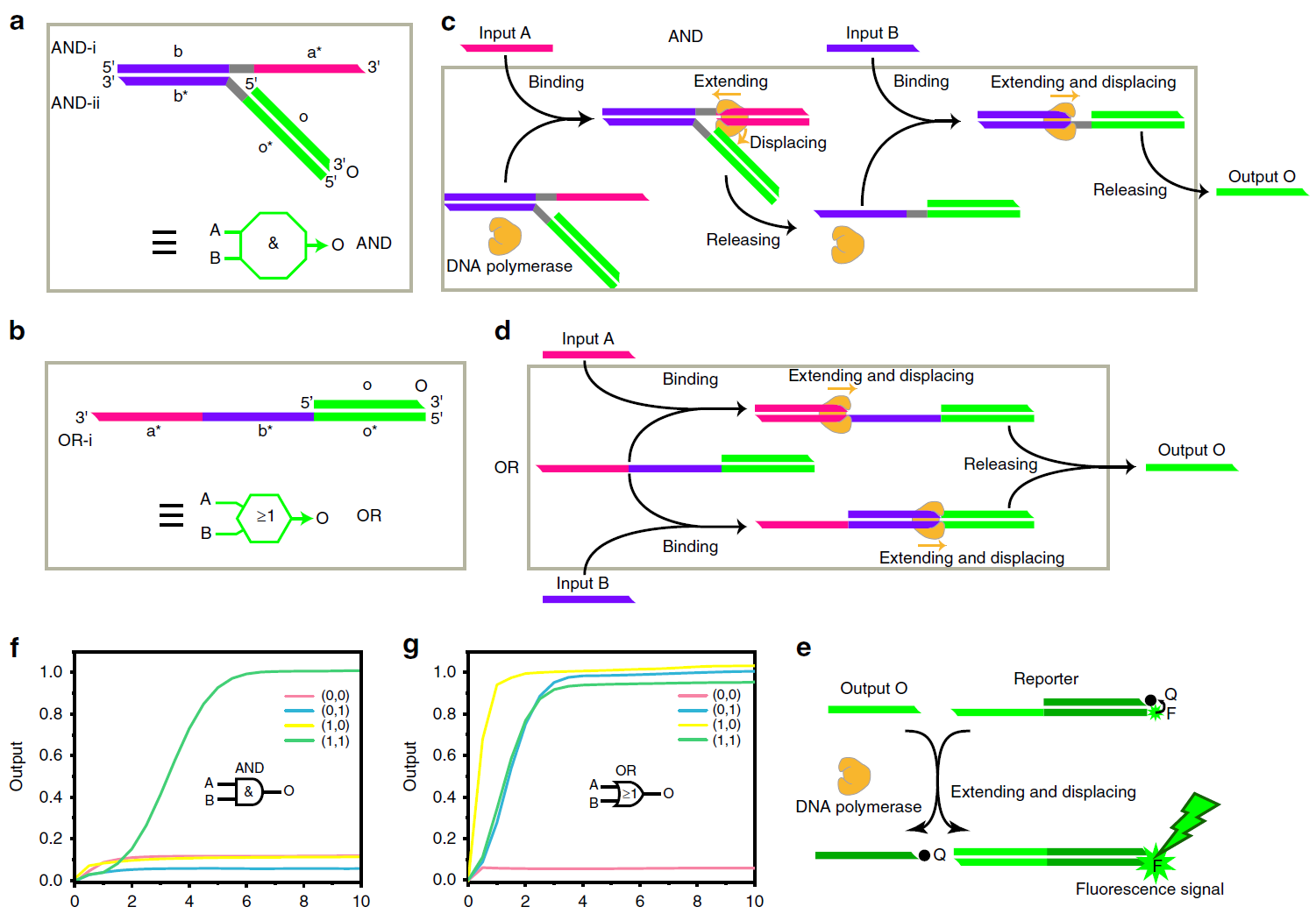
摘要:Powerful information processing and ubiquitous computing are crucial for all machines and living organisms. The Watson-Crick base-pairing principle endows DNA with excellent recognition and assembly abilities, which facilitates the design of DNA computers for achieving intelligent systems. However, current DNA computational systems are always constrained by poor integration efficiency, complicated device structures or limited computational functions. Here, we show a DNA arithmetic logic unit (ALU) consisting of elemental DNA logic gates using polymerase-mediated strand displacement. The use of an enzyme resulted in highly efficient logic gates suitable for multiple and cascaded computation. Based on our basic single-rail DNA configuration, additional combined logic gates (e.g., a full adder and a 4:1 multiplexer) have been constructed. Finally, we integrate the gates and assemble the crucial ALU. Our strategy provides a facile strategy for assembling a large-scale complex DNA computer system, highlighting the great potential for programming the molecular behaviors of complicated biosystems.
合写作者:Fuan Wang
第一作者:Haomiao Su, Jinglei Xu
通讯作者:Qi Wang, Xiang Zhou
论文编号:5390
学科门类:理学
文献类型:J
卷号:10
页面范围:5390
是否译文:否
发表时间:2019-12-26
收录刊物:SCI
发布期刊链接:https://www.nature.com/articles/s41467-019-13310-2