


New insight into toluene adsorption mechanism of melamine urea-formaldehyde resin based porous carbon: Experiment and theory calculation
发布时间:2024-09-30
点击次数:
DOI码:10.1016/j.colsurfa.2021.127600
所属单位:中南大学
发表刊物:Colloids and Surfaces A: Physicochemical and Engineering Aspects
关键字:Adsorption; GCMC; N-O co-doped; Porous carbon; Toluene
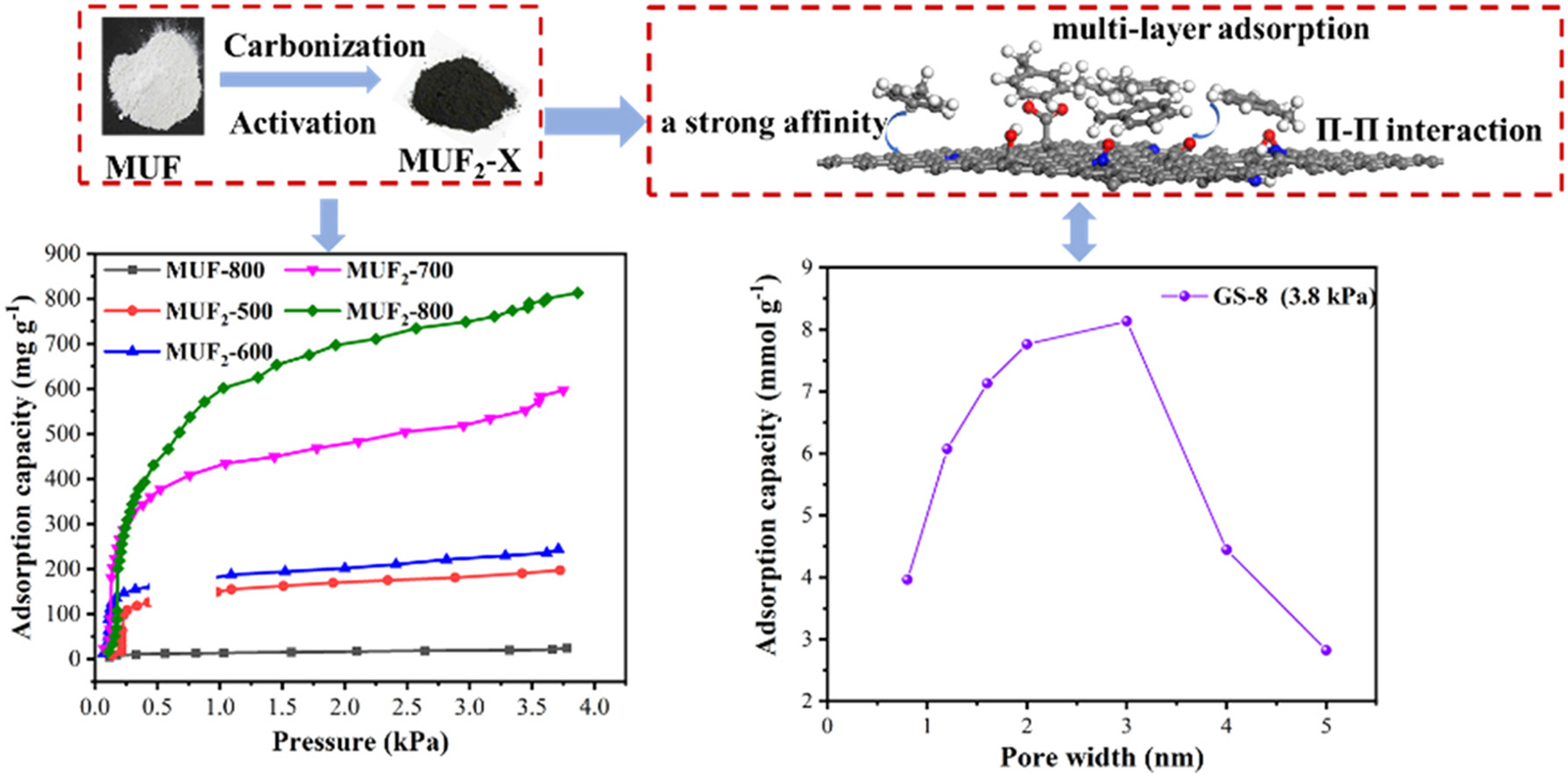
摘要:The N-O co-doped porous carbons with high specific surface areas and hierarchical pore structures were synthesized by KOH activation method using melamine urea-formaldehyde resin as the carbon precursor. The adsorption properties of toluene on all the samples were studied by experiments, density functional theory (DFT) calculation and grand canonical Monte Carlo (GCMC) simulation. Results showed N-O co-doped porous carbon exhibited a great specific surface area (2784.53 m2 g−1), a desirable pore volume (1.83 cm3 g−1), a high nitrogen (16.16%) and oxygen content (15.75%), and especially an excellent toluene adsorption performance (813.6 mg g−1, 25 °C). By correlating the adsorption capacity with physical and chemical property parameters, the main factors affecting the toluene adsorption were pore size and specific surface area. Furthermore, according to the theory calculation, the interaction between toluene and toluene can be improved by the N-O functional group and the multilayer adsorption can be formed. Considering this, we concluded that the optimal adsorption pore size of N-O co-doped porous carbons was 3–7 times as much as the toluene dynamic diameter. Such optimal adsorption pores not only provided a pathway and adsorption sites for toluene, but also had higher adsorption capacity of toluene. This study can be used to promote the molecular design of adsorbent of heteroatomic doping with an optimal adsorption pore size.
论文类型:期刊论文
论文编号:127600
卷号:632
ISSN号:09277757
是否译文:否
发表时间:2022-01-02
收录刊物:SCI
发布期刊链接:https://www.sciencedirect.com/science/article/pii/S0927775721014692?via%3Dihub
上一条: Nickel-rich NiCeLaFeCo medium-entropy alloy nanoparticles on oxygen and nitrogen co-doped carbon supports for hydrogen production from toluene cracking
下一条: Low platinum alloy catalyst PtCo3 obtaining high catalytic activity and stability with great water and CO2 resistance for catalytic oxidation of toluene