

DOI number:10.1016/j.apsusc.2024.159961
Affiliation of Author(s):中南大学
Journal:Applied Surface Science
Key Words:Activated carbon nanofibers; Adsorption; Density functional theory; Porous carbon; Volatile organic compounds
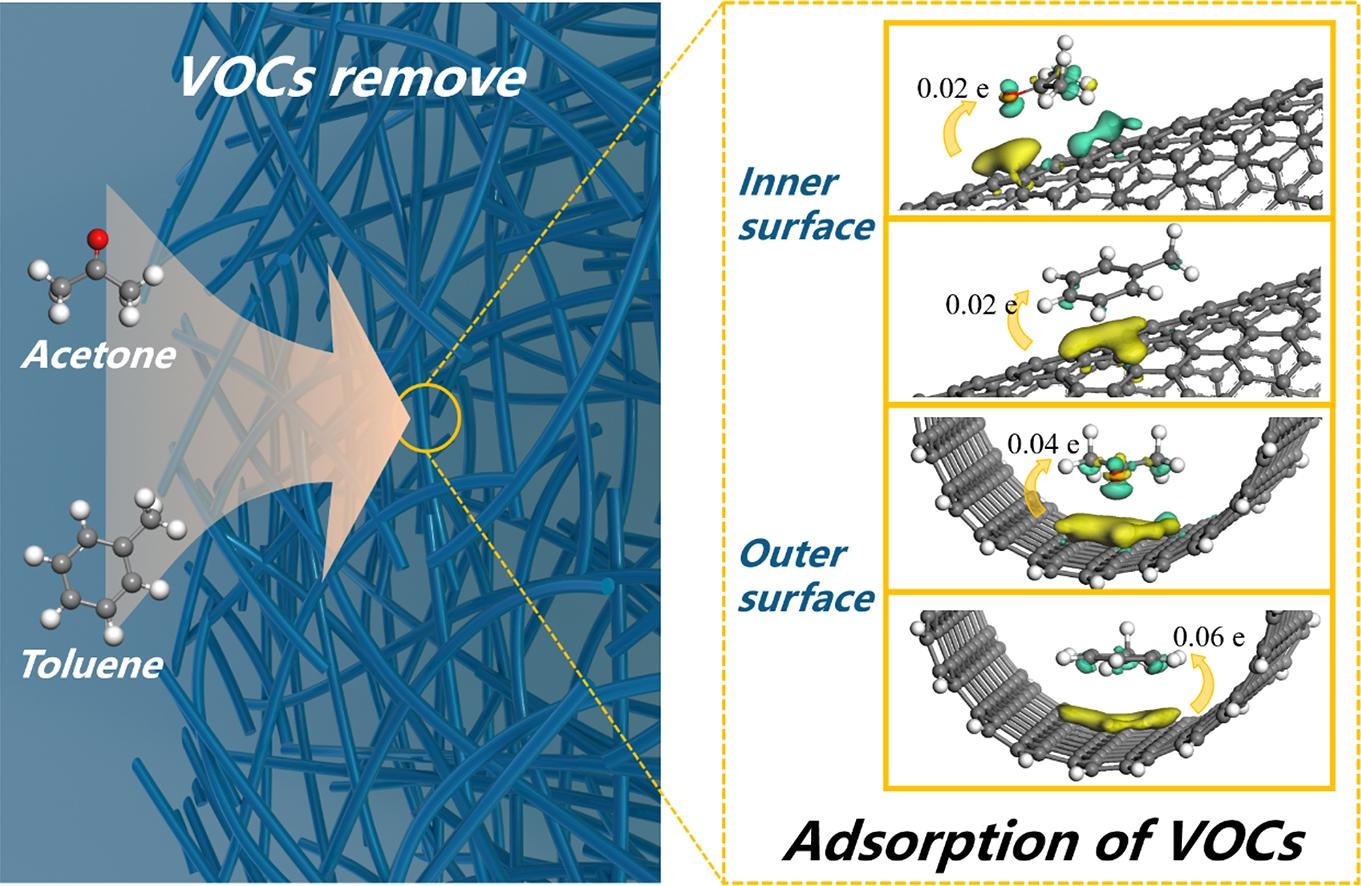
Abstract:The adsorption technology has been considered as an effective and economical strategy to control volatile organic compounds (VOCs) through various types of porous materials. As two potential porous materials, activated carbon and carbon nanofibers were synthesized as VOCs adsorbents. In order to investigate the difference in the adsorption of VOCs between activated carbon and carbon nanofibers, the specific surface area, pore structure and chemical functional groups of VOCs adsorbent were analyzed. In particular, the carbon nanofibers (CNF) activated at 800 ℃ showed an excellent specific surface area (2524 m2·g−1), abundant pores (1.66 mL·g−1), and rich functional groups (N: 8.29 at%). Meanwhile, the carbon nanofibers had a better adsorption performance for acetone (1069.82 mg·g−1) and toluene (427.72 mg·g−1) than activated carbon materials. Furthermore, the theoretical calculations were conducted to reveal the mechanism of favorable adsorption on the CNFs. The theoretical adsorption energies of CNF are −31.9 kJ·mol−1 (acetone) and −67.5 kJ·mol−1 (toluene), respectively, which have more favorable adsorption sites and stronger charge redistribution than activated carbon. This research guided the approach to obtain the porous carbon nanofibers and provided the evidence for CNFs (curved carbon) exhibiting a better adsorption ability to VOCs.
Indexed by:Journal paper
Document Code:159961
Volume:659
ISSN No.:01694332
Translation or Not:no
Date of Publication:2024-06-30
Included Journals:SCI
Links to published journals:https://www.sciencedirect.com/science/article/pii/S0169433224006743?via%3Dihub