

DOI number:10.1016/j.cej.2026.179527
Affiliation of Author(s):中南大学
Journal:Chemical Engineering Journal
Key Words:Electronic delocalization; Gas separation; GCMC&DFT; Graphitization; Multiple bonds; Porous carbon
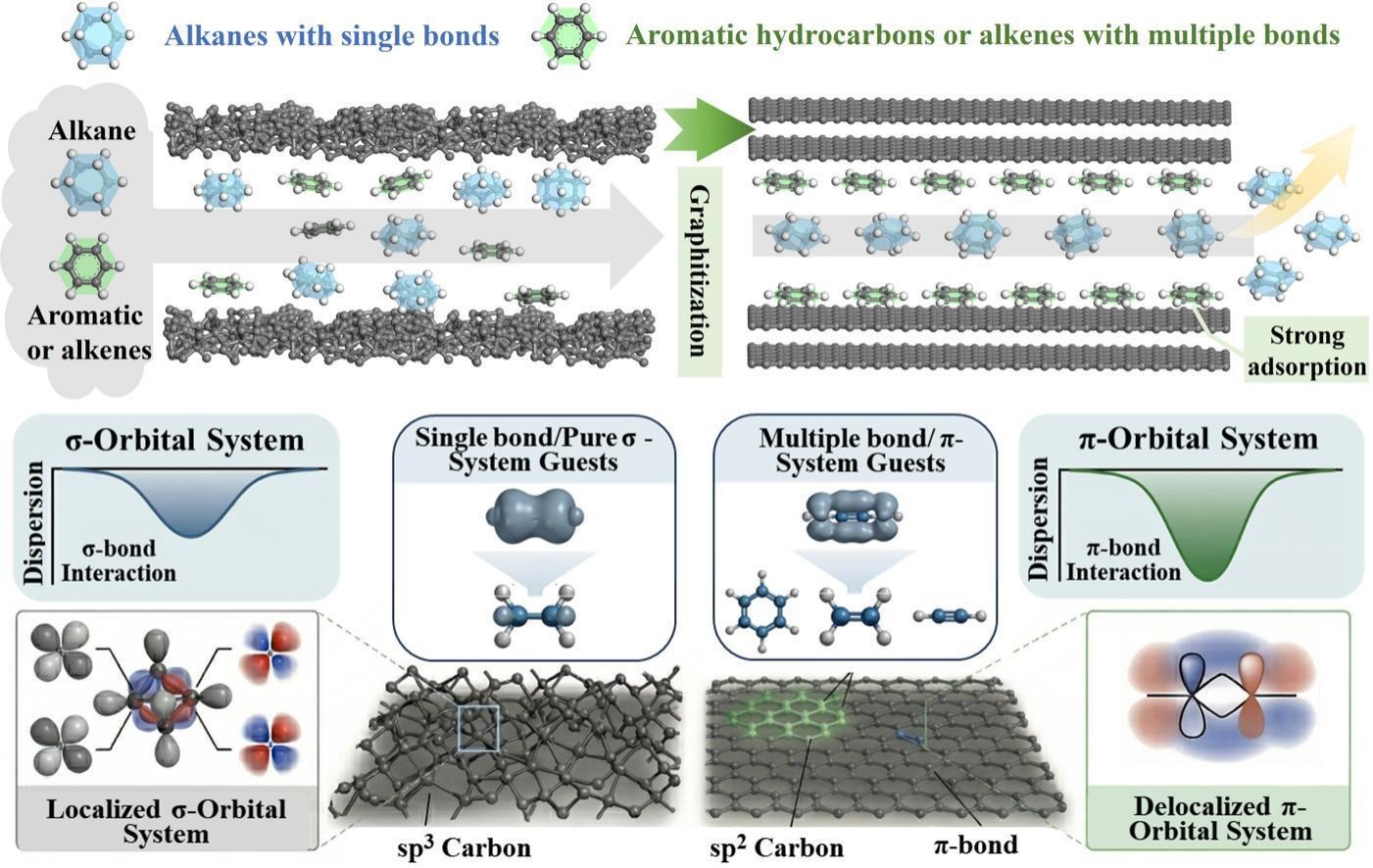
Abstract:The efficient separation of nonpolar organic molecules with similar kinetic diameters poses a significant energy challenge in petrochemical processes. Rather than relying only on conventional pore size sieving or polarity-based recognition, this work focuses on exploiting differences in electronic delocalization between guest molecules to improve adsorption selectivity. In the experimental section, we utilized biomass-derived porous carbon materials and employed graphitization modification techniques to enhance their surface electronic density, as evidenced by the increase in the Raman IG/ID ratio from 1.06 to 1.77. Adsorption experiments showed that the graphitized porous carbon materials significantly improved the adsorption selectivity of aromatic benzene over single-bonded cyclohexane, with selectivity increasing from 0.48 to 4.58. Grand canonical Monte Carlo (GCMC) simulations further indicated that the sp2-rich porous carbon structure effectively increased the micropore filling efficiency for benzene. More importantly, this study establishes a quantitative theoretical framework linking electronic delocalization with dispersion-dominated adsorption interactions. Density functional theory (DFT) calculations revealed that the enhanced dispersion adsorption in aromatic/multiple-bond systems originates from higher electronic density and π-electron delocalization. Further, we established a new dispersion factor (Dt) as a new quantitative descriptor to bridge electronic delocalization and adsorption-system-dependent dispersion strength. Using this descriptor, the delocalization-related dispersion interaction strength increased from 4.99 for sp3 carbon to 6.15 for sp2 carbon. This study provides a new theoretical framework and strategy for non-polar gas separation, showing tremendous potential for the separation of aromatics and alkanes.
Indexed by:Journal paper
Document Code:179527
Volume:545
Translation or Not:no
Date of Publication:2026-07-15
Included Journals:SCI
Links to published journals:https://www.sciencedirect.com/science/article/pii/S1385894726069883?via%3Dihub