

DOI number:10.1016/j.carbon.2026.121633
Journal:Carbon
Key Words:Hydrogen storagePorous carbon materialsStructural modificationBiomass utilizationHierarchical pore structure
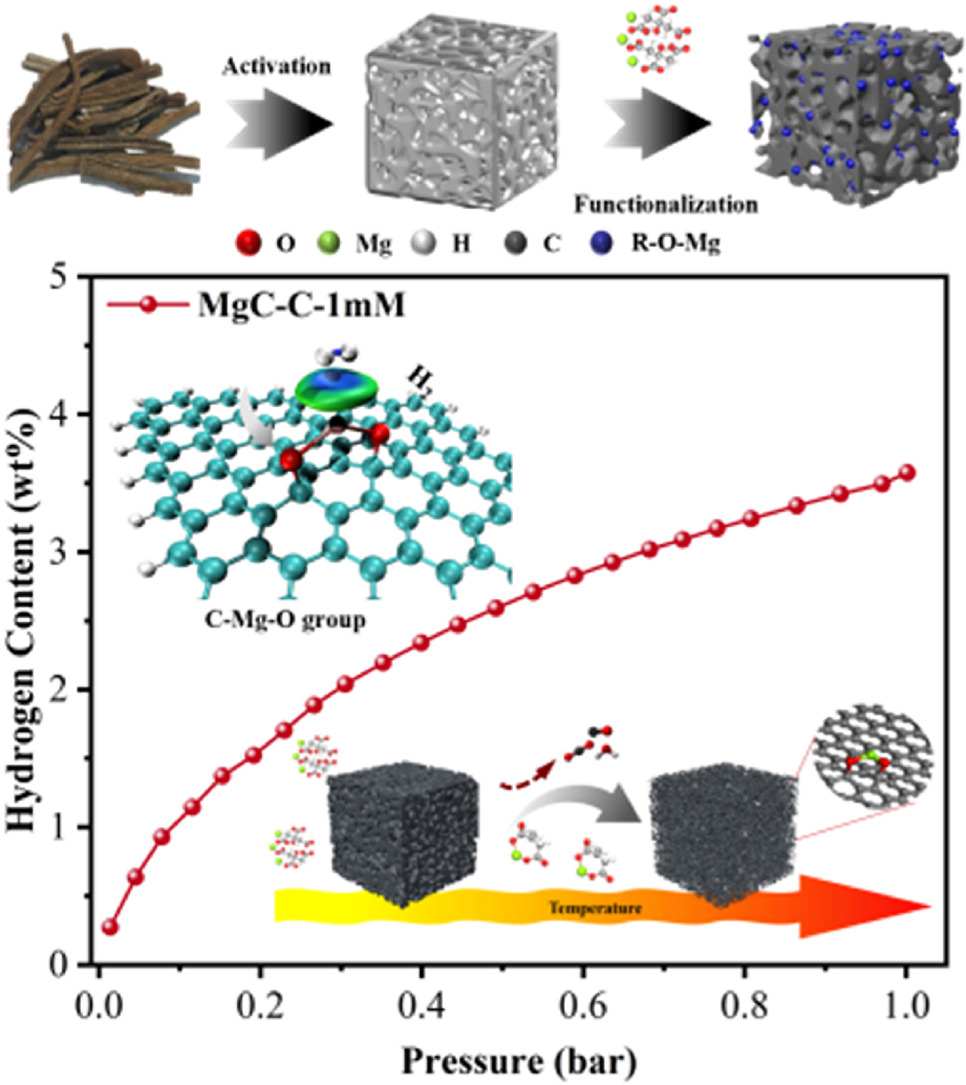
Abstract:Porous carbons face a critical trade-off between high surface area and weak H2 binding affinity, limiting their practical hydrogen storage capacity. Here, we circumvent this limitation by engineering a magnesium-decorated hierarchical porous carbon derived from tobacco stem waste through a dual-activation strategy with magnesium citrate. The multifunctional modifier serves a dual role: it functions as an in-situ porogen, yielding an ultrahigh specific surface area of 4577 m2 g−1 and a micropore volume of 1.45 cm3 g−1, while simultaneously introducing atomically dispersed C–O–Mg motifs onto the carbon matrix. This synergistic design achieves exceptional H2 uptake of 3.56 wt% at 1 bar and 5.80 wt% at 50 bar (77 K), markedly outperforming conventional porous carbons under low-pressure conditions. First-principles energy decomposition analysis (SAPT) reveals that the enhanced binding originates from a unique interplay of electrostatic and induction forces induced by the C–O–Mg groups, coupled with orbital hybridization between Mg 3s and H2 σ∗ orbitals. This work transforms biomass waste into a high-performance storage medium by decoupling the traditional porosity affinity trade-off, offering a sustainable blueprint for designing advanced adsorbents through targeted heteroatom engineering.
Indexed by:Journal paper
Document Code:121633
Volume:256
Translation or Not:no
Date of Publication:2026-04-28
Included Journals:SCI
Links to published journals:https://www.sciencedirect.com/science/article/pii/S0008622326004070?dgcid=coauthor