

DOI number:10.1002/slct.74132
Affiliation of Author(s):中南大学
Journal:ChemistrySelect
Key Words:acid treatment; catalytic ozone decomposition; high humidity resistance; Ni-doping; δ-MnO2
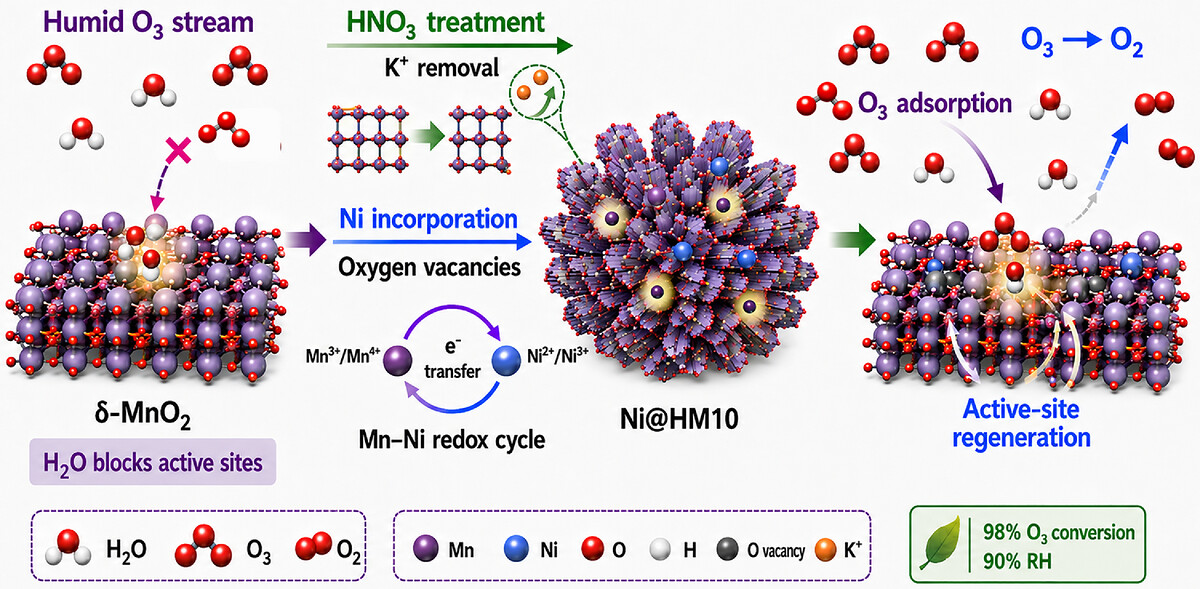
Abstract:The activity loss of δ-manganese dioxide (δ-MnO2) catalysts in humid environments is mainly caused by the competitive adsorption of water molecules on active sites. To address this issue, a series of Ni-doped and acid-treated δ-MnO2 catalysts were prepared for catalytic ozone decomposition. Acid treatment effectively removed interlayer K+ and promoted the formation of a dispersed nanoflower-like structure, which improved active-site exposure and water resistance. Ni incorporation further optimized the surface electronic structure, increased the oxygen vacancy (OV) concentration, and enhanced the synergistic redox interaction between Mn and Ni species. The optimal catalyst, Ni@HM10, maintained 98% ozone conversion for 10 h at 30°C, 90% relative humidity (RH), and a weight hourly space velocity (WHSV) of 840,000 mL·g−1·h−1. It also achieved 100% ozone conversion for 12 h under 100 ppm O3 and 50% RH. Density functional theory (DFT) calculations indicated that Ni doping strengthened ozone adsorption at OVs while weakening water adsorption, thereby promoting the preferential adsorption of ozone over water under humid conditions. This work provides an effective strategy for designing humidity-resistant, non-precious metal catalysts for ozone decomposition.
Indexed by:Journal paper
Document Code:e74132
Translation or Not:no
Date of Publication:2026-08-13
Included Journals:SCI
Links to published journals:https://chemistry-europe.onlinelibrary.wiley.com/doi/10.1002/slct.74132